

Most parrot owners spend a lot of time choosing the right cage and almost no time thinking about what goes inside it. The layout matters just as much as the enclosure itself and how you arrange your parrot's cage directly determines whether your bird stays mentally stimulated, physically active, and behaviourally balanced, or quietly bored, sedentary, and stressed. A cage filled with the wrong items in the wrong positions is not better than an empty one. In some ways it is worse.
This guide approaches cage setup the way an interior designer approaches a room with intention. Every element has a purpose, every position has a reason, and the finished result is a space that actively encourages your parrot to move, explore, forage, and play rather than sitting on one perch for hours on end.
At Birdsprees, we stock the cages, perches, toys, and enrichment accessories that make this kind of setup possible. This guide explains how to put them together in a way that actually works for the bird inside.
How Should I Arrange My Parrot's Cage? Start With a Clear Principle
Before placing a single perch or toy, establish one guiding principle: the cage should encourage movement. A well-designed cage layout prompts your parrot to travel between areas climbing, stepping across gaps, swinging down to forage, flying short distances if the size allows. A poorly designed cage puts everything within reach of one spot, and the bird never has a reason to move.
Think of the cage in three vertical zones: the lower third, the middle, and the upper area. Each zone serves a different behavioural function. The lower area is for foraging and ground-level exploration. The middle is for active play and movement. The upper area where parrots feel safest is for resting, sleeping, and high-status perching. A good cage layout gives your bird something to do in each zone without overcrowding any of them.
Overcrowding is the most common mistake in parrot cage design. A cage packed with perches, toys, swings, and accessories leaves no room to move which defeats the entire purpose. When in doubt, use less and leave more open flight space than feels instinctively right.

Cage Layout: Thinking in Zones Before You Add Anything
A functional cage layout begins not with adding items but with understanding the space itself. Measure the interior dimensions and mentally divide the cage into the three vertical zones described above. Note the positions of doors both the main door and any feeding doors and plan around them. A perch placed directly in front of a feeding door creates a barrier to access. A toy hung in the door swing path becomes a daily annoyance for both owner and bird.
Consider sight lines and security. Parrots are prey animals and feel most secure when they can see what is approaching them. Position primary perches so your bird has a clear view of the room and the main entry points. Avoid positioning the main sleeping perch in a corner where two walls meet at the back this creates a spot where the bird cannot see what is behind it, which produces chronic low-level stress in many species.
Food and water stations belong in the lower-to-middle zone, accessible from a perch but not positioned directly below other perches where they will be contaminated by droppings. Fixing food bowls mid-height on the cage wall rather than on the floor keeps them clean and creates a deliberate feeding station your parrot learns to associate with meals.
Perch Placement: The Most Consequential Decision in the Cage
Get perch placement right and the rest of the cage design falls into place. Parrots use perches not just to stand on but to navigate stepping between levels, stretching across gaps, gripping at different angles. Position perches at different heights with deliberate gaps between them, so your bird must step or reach slightly to move from one to the next. A cage where every perch is at the same height provides no movement incentive.
Vary diameter and texture throughout. A single perch diameter used consistently forces the foot into the same grip position all day causing pressure sores and joint problems over time. Rotate between natural branch perches of varying thickness, rope perches, and mineral perches to give the feet varied exercise and keep nails naturally worn. The thickest perch belongs in the upper zone as the primary resting perch the bird should grip it with toes wrapping roughly two-thirds of the way around.
Never position two perches directly above each other. The lower perch will be contaminated by droppings from above a detail that matters every single day.

Toy Positioning: Placement Determines Whether Toys Get Used
The most common toy complaint from parrot owners is that their bird ignores expensive items. In most cases, the problem is not the toy it is the toy positioning. A toy hung in an inaccessible corner, too close to a wall to swing freely, or placed in a zone the parrot never visits will be ignored regardless of its quality.
Position foraging toys and puzzle feeders in the lower-to-middle zone, where food-seeking behaviour naturally occurs. Parrots forage from below hanging a foraging toy at the top of the cage works against instinct. Swing toys belong in the mid-cage area with enough clearance on each side to move freely. Chewing toys work best near a perch with easy beak access, rather than requiring the bird to hang unsupported to reach them.
Rotate toys every one to two weeks. A toy in the same position for a fortnight becomes invisible. Reintroducing it in a different location a week later makes it novel again enough for most parrots to re-engage with it immediately.
Enrichment Zones: Building Distinct Areas for Different Behaviours
Enrichment zones take the three-tier vertical approach further creating distinct areas within the cage that prompt specific behaviours, the way different rooms in a home serve different functions.
A foraging zone in the lower area uses foraging cups, scatter feeding on the cage tray, or treat dispensers to encourage ground-level investigation. Parrots that forage actively are significantly less likely to develop feather-destructive behaviours linked to boredom. A play zone in the mid-cage area focuses on movement swings, ladders, rope bridges, and anything requiring physical engagement. Keep this zone the most open in the cage to allow free movement between items.
A rest zone in the upper area keeps the highest perch clear of toys and accessories. Parrots need a quiet, uncluttered high point to retreat to particularly before sleep. Cluttering the upper zone creates anxiety in a bird trying to wind down.
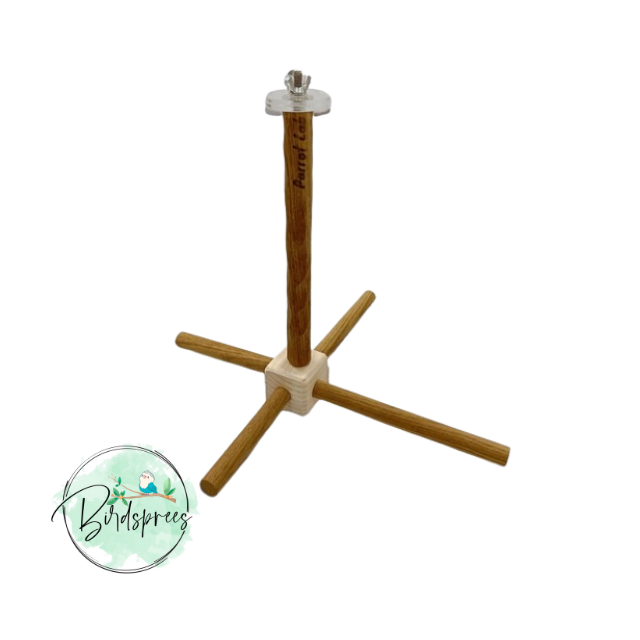
Safe Cage Design: What to Check Before Anything Goes Inside
Every item placed in a parrot's cage will be investigated with its beak which means toxicity, entanglement, and mechanical injury all need assessing before anything enters the enclosure. Safe cage design is not a one-time decision; it is an ongoing audit.
Natural wood perches from safe species apple, willow, hazel, and eucalyptus are ideal. Avoid branches from stone fruit trees such as cherry, plum, and apricot, which contain compounds toxic to birds. Check rope toys regularly for frayed fibres loose enough to catch a toe or neck. Replace rather than trim when rope toys deteriorate to this stage a strand that looks manageable can become a strangulation risk quickly.
Avoid toys with small detachable parts, zinc or lead components, and chain links wide enough to trap a beak or toe. Use stainless steel clips and fittings wherever possible galvanised wire can release zinc when chewed by a determined bird. The monthly cage inspection is also the right moment to audit every item inside for emerging safety issues.
A Thoughtfully Arranged Cage Is a Gift You Give Your Parrot Every Day
The time invested in arranging a parrot's cage well pays back in a bird that is visibly more active, more engaged, and more content. It reduces boredom-related behaviours, supports physical health through varied movement, and creates an environment the bird chooses to explore rather than one it merely tolerates.
Browse the full range of cages, perches, toys, and enrichment accessories at Bird Sprees, or contact our team for advice on building the right setup for your species and your space.
Frequently Asked Questions
-
How should I arrange my parrot's cage?
Divide the cage into three vertical zones — lower for foraging, middle for active play, and upper for resting. Position perches at different heights with gaps that encourage movement between them. Add foraging, play, and rest items to their respective zones without overcrowding any of them. -
How many perches should a parrot cage have?
Two to four perches of varying diameter and texture is the right range for most cage sizes. More than this creates overcrowding that restricts movement. Never position two perches directly above each other. -
Where should I put toys in a parrot cage?
Position foraging toys in the lower-to-middle zone, swing and mobile toys in the mid-cage area with enough clearance to move freely, and chewing toys near a perch with easy beak access. Rotate toys regularly to maintain novelty. -
What is the safest perch material for parrots?
Natural wood branches from safe species such as apple, willow, and hazel are excellent. Rope perches add variety and are safe when maintained. Avoid softwood dowel perches used exclusively, as uniform diameter causes foot pressure problems over time. -
How do I stop my parrot from sitting in the same spot all day?
Create deliberate movement pathways by positioning perches at different heights with intentional gaps between them. Add foraging activity in the lower zone to motivate ground-level exploration. Rotate toys regularly to break habitual perching patterns. -
Should I cover part of my parrot's cage?
Covering one or two sides of the cage, particularly a back corner, can create a sense of security for nervous birds. A fully covered cage restricts airflow and visibility. Partial covering is the better approach for most species. -
How often should I rearrange my parrot's cage?
Rotate toys every one to two weeks and reposition enrichment items monthly to maintain novelty. Major layout changes, such as moving primary perches, should be done gradually, as sudden significant changes can temporarily stress a bird accustomed to its environment.